
A follow-up to a blueprint for re-industrialization. There I mapped what's broken across five interconnected stakeholders in America's re-industrialization: industry, capital, education, tech and government. A lot has happened in just 8 months. A question nonetheless remains: why hasn't the capital reached the floor?
There's a whole class of company every reindustrialist can describe and capital still doesn't quite understand.
These businesses already work and make up much of our industrial base. They have revenue, employees, and often a backlog of real orders. This is the shop making better castings, a thermoplastics manufacturer building its own machines, the kind of capital-intensive business that needs to innovate to be able to grow—because they cannot access growth capital.
The problem is that nobody knows how to price this. They might be cash flowing and still starving for capital because the money to grow costs too much. Venture won't touch it, because it's not a power-law bet and the innovation isn't a 50-100x outcome in 10 years. The banks that should serve it don't have the same relationship they used to, so they underwrite the auction value of its machines instead of the order book. A homebuilt machine has no auction value at all, even when it's the most valuable thing on the floor. It's badly banked, and equity financing was never on the table for a business like this.
Before software ate the world, venture capital was not how companies were funded. Venture is a recent monoculture that now dominates how ambitious things get funded in America.
Hard assets are a bad fit for VC. They're capital intensive, margins are thin until scale and the moat typically comes after the expensive part. It's really expensive and hard to start a manufacturing company. And really expensive and hard to scale a manufacturing company.
This is why you're (probably) not going to start seeing 20 new steel mills pop up in the next YC batch, because capital-intensive industrials businesses are risky and inherently a worse fit for venture capital.
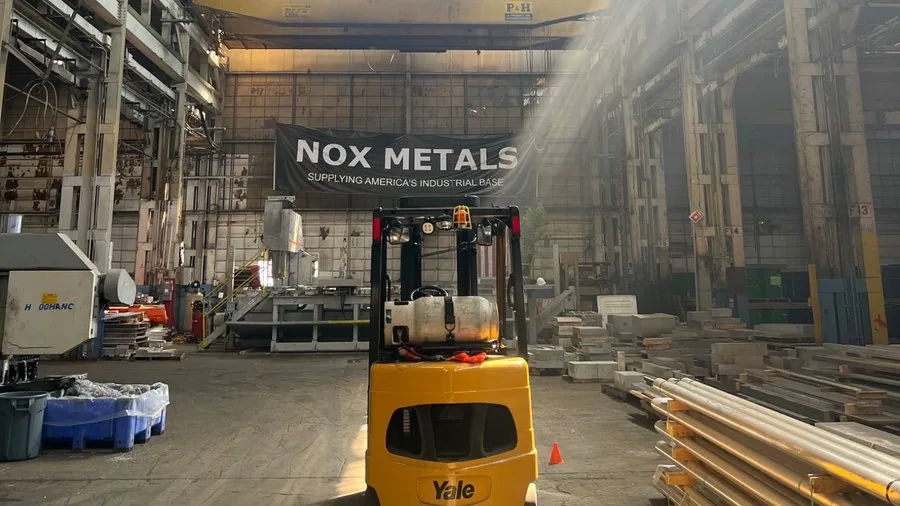
There are exceptions. A company like Nox Metals (above) went the venture route, even though it isn't typically built for a business like this. Without other financial instruments, they used venture to blitzscale early and are seeing early wins on speed.
While their growth rate has resembled software, the behemoth that Zane is building isn't actually a software business at all. It's a bunch of dudes cutting metal. Faster, better, cheaper (and cooler) than anyone else. He made venture work, but most of the base will never have that option.
America has the deepest capital markets in the world. So it's strange that the institution doing the most for industrial capitalization is the Small Business Administration. They've designed a better debt rail for the companies that actually carry the industrial base, priced on what they can do instead of what they can pawn. By taking the boring risk off the table, they clear the way for other investors to buy into reindustrialization.
Capital flows to legible risk
Legibility to capital seems to be a moving target for non-obvious industries. Venture capitalists hold a lot more power today for those starting companies than they did 30 years ago.
Software spent a few decades making itself legible to money. Surely if you've raised capital, a junior VC has asked about your LTV/CAC, or your ARR. And these numbers travel pretty well: you can price a SaaS company on a zoom call without ever meeting them in person because these are crystal clear metrics. As Will Manidis so eloquently wrote, capital pools to places where outcomes are clear.
The factory is opaque. Things that make manufacturing businesses valuable are very different than what a bank might deem valuable. After all, you can't really quantify twenty years of feel for when a spindle is about to drift, a relationship that gets a rush order through heat-treat in days instead of weeks or the value of building your own capex. So when the shop asks for a loan, the bank does the only thing it can do with illegible risk: it ignores capability entirely and underwrites collateral, or the auction value of used machines. The best-run shop in the county and the worst one might get the same terms, because on paper they look nearly the same.

This information failure compounds in a frustrating way. Illegible businesses get expensive capital if any, expensive capital starves growth, starved firms can't invest in becoming legible. Even if a shop lands the biggest order in its history, it may die trying to service it because the contract pays net-90 or 120 while the material bill is due next week.
I like to look at the German Mittelstand as a model. While the culture around apprenticeships and trades drives much of its durability, they have structural financial advantages as well. Every German manufacturer has a Hausbank, a "home bank," a local lender that doesn't have to maximize profit and has a standing interest in preserving the relationship across decades.
Because the banks are local, they're structurally prevented from the pro-cyclical reflex of yanking credit the moment business turns down. When a borrower's rating slips a notch, a Hausbank increases its loan supply while an arm's-length lender pulls back. Seems counterintuitive, but the relationship itself underwrites the loan. The German banker who has known the shop for thirty years understands tacit capability in ways that cannot be represented in a spreadsheet.
America had this. As late as the mid-1980s, there were over 14,000 commercial banks in the United States. One side effect of financial deregulation was that our banking system consolidated into a handful of national giants whose credit models only see collateral and a FICO score. Financial crises only caused more consolidation. While we still have ~4,000 that play a major role in SMB and agricultural lending, capital is much more constrained and selectively available.
In the blueprint, I argued this is a gap the SBA should fill: purchase-order financing, growth lending for working capital, etc. What's happened in the time since has blown my mind.. they're putting up Wilt Chamberlain numbers in a relatively short time frame for a government agency.
The SBA
In March 2025, the SBA stood up a Made in America Manufacturing Initiative with a new Office of Manufacturing and Trade, then sent its people on a multi-state roadshow to sit in roundtables with small manufacturers and ask what was actually broken. This was textbook "go and see" behavior. Good stuff.

In September, the SBA shipped MARC, the first lending product in the agency's history designed specifically for manufacturers. Revolving credit and term loans to $5M, aimed squarely at the payment term trap I mentioned above, built in their words for maximum flexibility and minimal red tape. The same month, upfront fees on 7(a) manufacturing loans under $950K went to zero, and 504 fees for manufacturers were waived entirely. By December, the first $3.5M in MARC loans had reached actual shops, and when it became clear that machinery inflation had made the old $5M ceiling a bottleneck for anyone trying to modernize, Congress and the agency doubled the combined 7(a)/504 cap to $10M.
The most unexpected takeaway from this administration is that the SBA is leading the charge on industrial and financial products for manufacturers. A federal guarantee like this one is synthetic relationship banking, and bigger than any single loan. We can't conjure 14,000 thirty-year banking relationships by next quarter, so the SBA does the next best thing and underwrites the part of the risk a national bank can't see on its own. A partial guarantee like this unlocks several times its value in private lending. It isn't subsidizing risk so much as translating it, standing in for the local banker who used to vouch for the shop.
If that sounds like a setup for abuse, it should because we've run a similar experiment before. The S&L crisis happened because the government guaranteed downside and deregulated what banks could invest in. Deposit insurance covered thrifts 100% while they gambled in markets they didn't really understand, and left the taxpayers with a $124B bill. Fortunately, the SBA considers this. The originating bank keeps 15-25% of every loss on its own books, so a lender retains exposure to their own downside. And my take: this works so long as someone is watching. Watch the default rates by originator.
There's a defensible reason it should be the public holding that risk, not just an expedient one. When a shop expands, most of the value permeates well past its own income statement: into denser supplier networks, into apprentices who carry skills to the next employer, into American supply-chain resilience more broadly. Private lending systematically underfunds manufacturing because that value is hard to capture, more public good than individual private return.
A big fear for many operating inside the American manufacturing base was that renewed government money would once again cluster in defense, as it always has. For the first time in a generation, the SBA is pointing industrial and financial policy at the broad civilian manufacturing base, the 98% of manufacturers that are small businesses. The SBA has a chance to build a new American Mittelstand—though not without the help from others.
Capacity hurdles
A guarantee from the SBA fixes the debt problem, but there are things that money cannot buy.
As far as money goes, it cannot buy individual capability. A homegrown machinist, for example, is roughly a five-year build, a toolmaker even longer and the curriculum is largely passed hand to hand. This becomes a capacity constraint when a machine slot opens up and there's nobody to run it. You can buy more machines with money, the same is not always true for people.
The SBA's E2G initiative gestures at this with workforce grants, and the gesture is right, but the speed mismatch between capital and craft remains the binding constraint of the whole project. It's on the schools themselves to follow the SBA's lead, and that deserves its own essay.
Debt is great for financing the expansion of what already works and useless at financing the invention of what doesn't. For all the strength of Germany's bank-based system, the country is infamous for their equity gap, low equity ratios, a weak startup ecosystem, and decades of public attempts to stand up state equity funds to fix it.
Because debt has capped upside, a lender's best case is getting paid back, and an instrument with capped upside mathematically cannot price uncapped uncertainty.
In the case of most of our industrial base, marginal funding for marginal growth is exactly what's needed. More cash infusions for working capital to fuel growth of our industrial base. This breaks when you start talking about a new material or process that can expand the production possibilities curve - expanding what a factory can build.
Debt is not right here because an instrument that can only get paid back is blind to the investment whose whole value is the frontier expansion, especially when it's also difficult to collateralize.
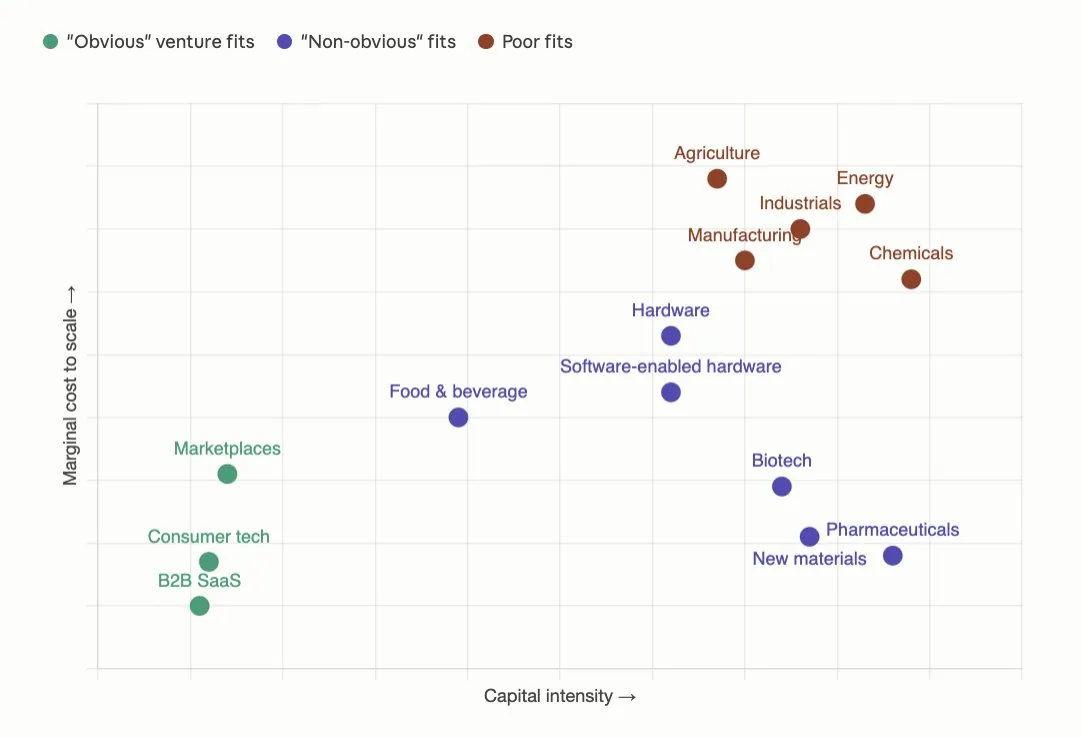
This is the one place the venture model, for all its mismatch with hard assets, is structurally correct: only uncapped-upside capital can price uncapped risk. The chart above marks the purple industries "non-obvious" because classic venture wants the software risk curve, while growth and private equity want the longer time horizon, cash-flowing business. The frontier between them, which is capital-intensive and risky, is orphaned.
SBIC is too small for this. MARC is a great program to fund the industrial base with debt. Nothing at scale yet funds the leap to the "Industry 4.0" everyone keeps talking about, and that gap is an equity gap, not a debt one.
But here the SBA does more than it gets credit for. It doesn't fund the frontier companies, and it shouldn't. It's a debt institution. Instead the SBA clears the way for other investors to pile in. Equity's real fear in capital-intensive businesses is that an otherwise winning company dies from lack of working capital, regardless of whether the core idea works. By derisking that layer, the SBA lets an equity check go toward the actual frontier risk instead of plugging a cash-flow hole.
The new SBA policy allows a company to separate the risk that looks like every other manufacturer's from the risk that's genuinely new, and makes the second one legible enough to underwrite. The patient equity vehicle still has to be built. Venture is leading the way on investing in "deeptech" and "hardtech", but funding the leap at scale will take capital that behaves like venture on the upside and like an industrialist on the time horizon. The SBA made the purple territory materially more investable.
All that to say, the best way to fund a factory is by putting in orders.
Setting a precedent
The SBA was a rogue pick for America's conduit to reindustrialization, but it plays a critical role once you remember that 98% of manufacturers are small businesses. In the blueprint I argued we needed a new cabinet-level body, a MITI, an EPB, because I assumed policy coherence had to be built greenfield. The SBA spent 2025 and 2026 suggesting I was wrong in the most encouraging way possible: an existing institution, handed a clear target, listened and incorporated real feedback, then produced coherent industrial finance policy.
This sets a precedent worth more than the capital it unlocks, because it reveals the real constraint was never capacity. If the SBA can remake itself into a synthetic Hausbank for American industry, surely Commerce, DOL and Treasury can coordinate with the MEPs and fifty state development agencies to build more tools for our industrial base. Every argument that reindustrialization requires some grand structural overhaul from the top is being mogged by the most boring agency in Washington.
Coherent industrial policy can come from the most unlikely of places, insofar as people are willing to move mountains to make something happen.